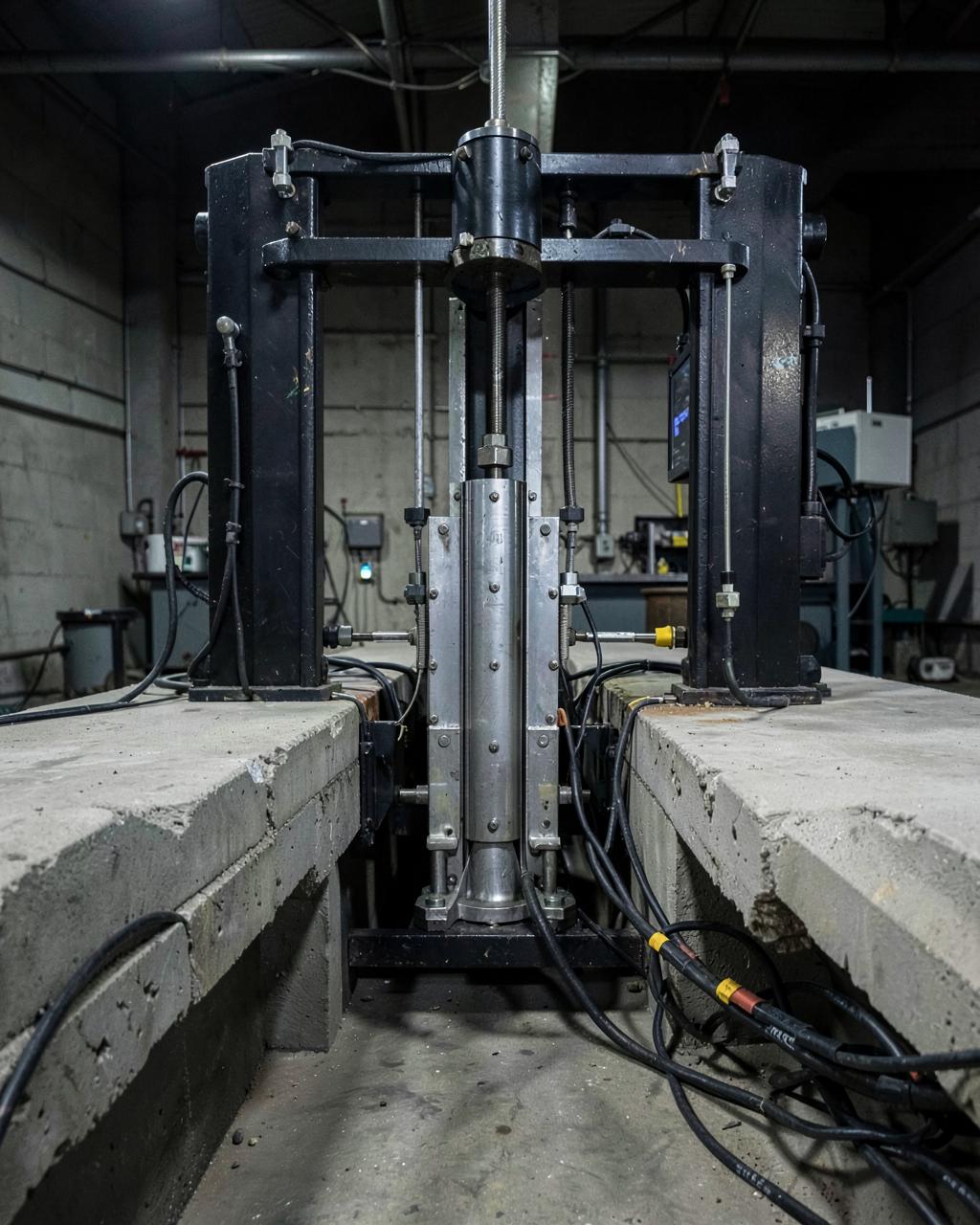
Bridge expansion joints are among the most safety-critical — and most heavily stressed — components in road infrastructure. They must accommodate continuous thermal movement, absorb millions of traffic load cycles, and maintain watertightness over decades of service. Getting the testing right is not optional; it is essential to public safety and regulatory compliance under the Construction Products Regulation.
What Are Bridge Expansion Joints?
An expansion joint is the engineered connection that bridges the gap between adjacent structural elements of a bridge — typically between the deck and the abutment, or between successive deck segments. As temperatures change, concrete and steel expand and contract. Without a properly designed and tested joint, these movements would cause cracking, structural distress, and ultimately failure of the bridge deck or substructure.
The European regulatory framework recognises seven distinct categories of bridge expansion joint, each covered by its own European Assessment Document (EAD):
- Flexible plug joints (synthetic polymer binder) — EAD 120011-01-0107
- Flexible asphaltic plug joints — EAD 120093-00-0107
- Nosing joints — EAD 120109-00-0107
- Mat joints — EAD 120110-00-0107
- Cantilever joints — EAD 120111-00-0107
- Supported joints — EAD 120112-00-0107
- Modular joints — EAD 120113-00-0107
Each type addresses different movement ranges and load capacities. Flexible plug joints handle small movements (typically up to ±25 mm), while modular joints — consisting of multiple seal elements separated by steel centre beams — can accommodate movements exceeding ±1,000 mm.
From ETAG 032 to Individual EADs
Historically, bridge expansion joints were assessed under ETAG 032 (Edition May 2013), which served as the single guideline for European Technical Approval. However, ETAG 032 has been superseded and is no longer used for new assessments. It has been replaced by the seven individual EADs listed above, all published in August 2019 and cited in the Official Journal of the European Union via Commission Implementing Decision (EU) 2020/1574.
This transition reflects the broader shift within EOTA from multi-product ETAGs to focused, product-specific EADs. Each EAD is tailored to the specific performance characteristics and failure modes of its joint type, resulting in more precise and technically robust assessments.
Existing ETAs issued under ETAG 032 remain valid until their expiry date, but all new applications and renewals must reference the applicable individual EAD.
Essential Characteristics Assessed
Regardless of joint type, the EADs require assessment of the following essential characteristics:
- Watertightness: The joint must prevent water ingress to the bridge substructure under all movement conditions. Water penetration is the primary cause of corrosion in bearings, reinforcement, and abutment concrete.
- Movement capacity: Horizontal (longitudinal and transverse), vertical, and skew movements must be accommodated without loss of function or watertightness.
- Fatigue resistance: Joints must withstand millions of movement and load cycles representing the full design service life — typically 50 years or 2 million equivalent heavy vehicle passes.
- Load-bearing capacity: Static and dynamic wheel loads and braking forces must be transmitted safely through the joint to the bridge structure.
- Durability: Resistance to ageing, UV radiation, ozone, temperature extremes, and chemical exposure (de-icing salts, fuel spillage).
- Noise emission: Traffic-induced noise from the joint must be characterised, particularly for joints in urban or noise-sensitive locations.
- Slip resistance: The running surface must maintain adequate skid resistance under wet and dry conditions.
Key Test Methods
The testing programme for bridge expansion joints is among the most demanding in construction product assessment. Below are the principal test methods specified across the EADs.
Fatigue and Cyclic Movement Testing
This is the cornerstone of expansion joint assessment. The joint specimen is subjected to cyclic horizontal movements at the declared movement range while simultaneously applying vertical wheel loads. The number of cycles is determined by the design service life and traffic intensity — typically in the range of 500,000 to 2,000,000 cycles. Throughout testing, the joint must maintain its structural integrity and watertightness. Any cracking, delamination, or seal failure constitutes a test failure.
Watertightness Under Movement
Water is applied to the joint surface while the joint is cycled through its full movement range. Water penetration below the joint is measured and must remain below specified thresholds. This test simulates real-world conditions where rainfall coincides with thermal movement.
Static and Dynamic Load Testing
Concentrated wheel loads (typically representing a single heavy vehicle wheel of 80–120 kN) are applied statically and dynamically to the joint surface. Deflections, stress distributions, and any permanent deformation are measured. For modular joints, the load distribution to individual centre beams and support bars is verified.
Movement Capacity Verification
The joint is moved to its extreme positions — maximum opening, maximum closing, and maximum skew and vertical offset — and inspected for damage or loss of function. This verifies the manufacturer's declared movement capacity and ensures adequate reserves exist.
Durability and Ageing Tests
Elastomeric and polymer components are subjected to accelerated ageing protocols, including:
- Temperature cycling (typically −30 °C to +70 °C)
- UV exposure (xenon arc or equivalent)
- Ozone exposure at elevated concentrations
- Immersion in de-icing salt solutions
- Fuel and oil resistance (for joints in the carriageway)
After ageing, the components are retested for mechanical properties (tensile strength, elongation at break, hardness) and compared to unaged reference values.
Noise Emission Testing
Traffic noise generated by vehicles crossing the joint is measured using standardised methods. The noise level is compared to a reference road surface, and the difference is reported as the noise emission characteristic. This is particularly relevant for nosing, cantilever, and modular joints where tyre–steel contact generates significant noise.
AVCP System and Certification
Bridge expansion joints fall under AVCP System 1 as defined by the Construction Products Regulation (EU) No 305/2011. This is the second-most stringent assessment system and requires:
- Type testing — performed by an accredited testing laboratory (ISO 17025)
- Factory production control (FPC) certification — initial inspection and continuous surveillance by an accredited certification body (ISO 17065)
- Certificate of constancy of performance — issued by the certification body on the basis of type testing results and FPC assessment
The manufacturer draws up the Declaration of Performance (DoP) and affixes CE marking on the basis of the ETA and the certificate of constancy of performance.
Factory Production Control (FPC)
FPC is the manufacturer's internal quality management system specific to the production of expansion joints. Under System 1, the certification body must:
- Carry out an initial inspection of the manufacturing facility and FPC system
- Conduct continuous surveillance (typically annual audits) to verify ongoing conformity
- Review production records, incoming material controls, in-process testing, and final product inspection
- Verify traceability of raw materials and components
FPC requirements are specified in detail within each EAD. They cover raw material testing (e.g., hardness and tensile properties of elastomers, chemical composition of steel), dimensional controls, welding quality (for steel components), and functional testing of finished assemblies.
The ETA Route: Why It Is Required
There is no harmonised European standard (hEN) covering bridge expansion joints. This means the only pathway to CE marking is via a European Technical Assessment (ETA) issued by a Technical Assessment Body (TAB) on the basis of the relevant EAD.
The ETA process involves:
- Application to a TAB with full product documentation
- Assessment programme agreed between the TAB and the manufacturer, referencing the applicable EAD
- Type testing at an accredited laboratory covering all essential characteristics
- ETA issuance documenting assessed performance — valid for 5 years and renewable
- AVCP by an accredited certification body, leading to the certificate of constancy of performance
Manufacturers should engage early with both the TAB and the testing laboratory to align on specimen requirements, test parameters, and documentation format.
Common Failure Modes: What Testing Prevents
Real-world failure of expansion joints is costly and disruptive. Common failure modes include:
- Fatigue cracking of elastomeric seals or steel components after insufficient cyclic resistance
- Loss of watertightness leading to substructure corrosion, bearing damage, and concrete deterioration
- Debonding of flexible plug or asphaltic plug joints from the surrounding road surface
- Excessive noise from worn or poorly designed metal-to-metal contacts
- Debris accumulation in modular joint gaps, preventing movement and causing overstress
- Corrosion of steel centre beams, support bars, or anchor systems
- Loss of slip resistance on the running surface, creating a road safety hazard
Rigorous type testing under the EAD framework is specifically designed to identify and prevent these failure modes before products reach the market.
How Amstelfy Supports Manufacturers
Amstelfy provides comprehensive support for bridge expansion joint manufacturers seeking European market access:
- Accredited testing (ISO 17025): Full type testing programmes covering fatigue, watertightness, load capacity, movement, durability, and noise emission — performed in our own laboratory facilities.
- FPC certification (ISO 17065): Initial inspection and ongoing surveillance of factory production control systems, leading to the certificate of constancy of performance required under AVCP System 1.
- ETA consultancy: Support with ETA applications, liaison with Technical Assessment Bodies, test programme planning, and documentation preparation.
- Regulatory guidance: Expert advice on the transition from ETAG 032 to the current EAD framework, including assessment of existing ETAs and planning for renewals.
Whether you are bringing a new expansion joint product to market or renewing an existing ETA under the current EAD framework, our team can guide you through every stage of testing, assessment, and certification.