Liquid Applied Roof Waterproofing Kits — commonly abbreviated as LARWK — are among the most versatile systems available for waterproofing flat and complex-geometry roofs. Historically assessed under ETAG 005, LARWK products are today evaluated under EAD 030350-00-0402, which sets the European framework for their essential characteristics, testing, and CE marking under the Construction Products Regulation (EU) No 305/2011.
What Is a LARWK?
A Liquid Applied Roof Waterproofing Kit is a factory-produced set of components — one or several liquid resins (polyurethane, polymethyl methacrylate (PMMA), unsaturated polyester, bituminous, silicone, or hybrid chemistries), reinforcement fabrics, primers, top coats, and ancillary detailing products — that together form a seamless, in-situ cured waterproofing membrane on the roof substrate.
Unlike sheet membranes, a LARWK is applied wet and cures on-site into a continuous, joint-free layer, which makes it especially suitable for:
- Roofs with complex geometry, penetrations, upstands, and details where sheet membranes are difficult to install
- Refurbishment of existing roofs where lifting the old covering is not desired
- Green roofs, ballasted roofs, and roofs with photovoltaic installations that need a robust, fully bonded waterproofing layer
- Balconies, walkways, and terraces where mechanical resistance and slip resistance are required
From ETAG 005 to EAD 030350-00-0402
Until 2013, LARWK were assessed under ETAG 005 — Guideline for European Technical Approval of Liquid Applied Roof Waterproofing Kits. With the entry into force of the Construction Products Regulation, ETAGs were converted into European Assessment Documents. LARWK are now assessed under EAD 030350-00-0402 — Liquid applied roof waterproofing kits, published by EOTA and cited in the Official Journal of the European Union.
Any new European Technical Assessment (ETA) issued for a LARWK — and any renewal of previously issued ETAs — must reference the current EAD. Certificates and Declarations of Performance still referencing ETAG 005 alone are no longer compliant.
Essential Characteristics Assessed under EAD 030350-00-0402
The EAD defines the essential characteristics that must be declared in the manufacturer's Declaration of Performance. The core assessment covers:
- External fire performance: Classified according to EN 13501-5 (BROOF(t1) to BROOF(t4)).
- Reaction to fire: Euroclass A1 to F according to EN 13501-1.
- Watertightness: Ability of the cured membrane to resist water penetration under defined hydrostatic and dynamic conditions.
- Resistance to wind load: Pull-off resistance of the fully bonded system from the substrate under uplift.
- Resistance to static and dynamic indentation: Ability to withstand traffic, maintenance loads, and impact from hail or dropped tools (EN 12730, EN 12691).
- Water vapour permeability: Sd value for moisture management of the roof build-up.
- Working life category (W1, W2, W3): Assumed working life of 5, 10, or 25 years assessed through accelerated ageing.
- Climatic zone (M, S): Moderate or Severe climate zone suitability.
- User load category (P1–P4): Low to very high mechanical stress from traffic and use.
- Roof slope category (S1–S4): From flat roofs to steep pitched applications.
- Lowest and highest surface temperature (TL, TH): Temperature range over which the membrane retains its performance.
- Dangerous substances: Content and release assessed against the applicable European and national provisions.
Key Test Methods
Testing under EAD 030350-00-0402 is extensive because a LARWK must simultaneously behave as a waterproofing barrier, a durable coating, and — in many cases — a trafficable surface. Below are the main test families performed in an accredited ISO/IEC 17025 laboratory.
Watertightness
Cured membrane samples are exposed to a defined water head on their upper surface for a specified time (typically 24 hours at 60 mm head according to EN 1928, method A or B). The underside is inspected for any sign of water passage. The test is repeated on samples that have first been subjected to ageing and to mechanical damage, to verify long-term watertightness under realistic conditions.
Artificial Ageing
The working life category (W1, W2 or W3) is verified through accelerated ageing protocols that combine UV irradiation, elevated temperature, and water spray according to EN 1297 and complementary EOTA procedures. After ageing, samples are re-tested for watertightness, crack-bridging, tensile strength and elongation. Retention of properties within specified thresholds determines the declared working life.
Crack Bridging
The membrane is applied over a substrate that is then subjected to a controlled crack opening (static or dynamic) at low temperature. The membrane must bridge the crack without rupture or loss of watertightness. This is critical for concrete decks and cement-based substrates that will develop cracks in service.
Wind Uplift / Pull-off Resistance
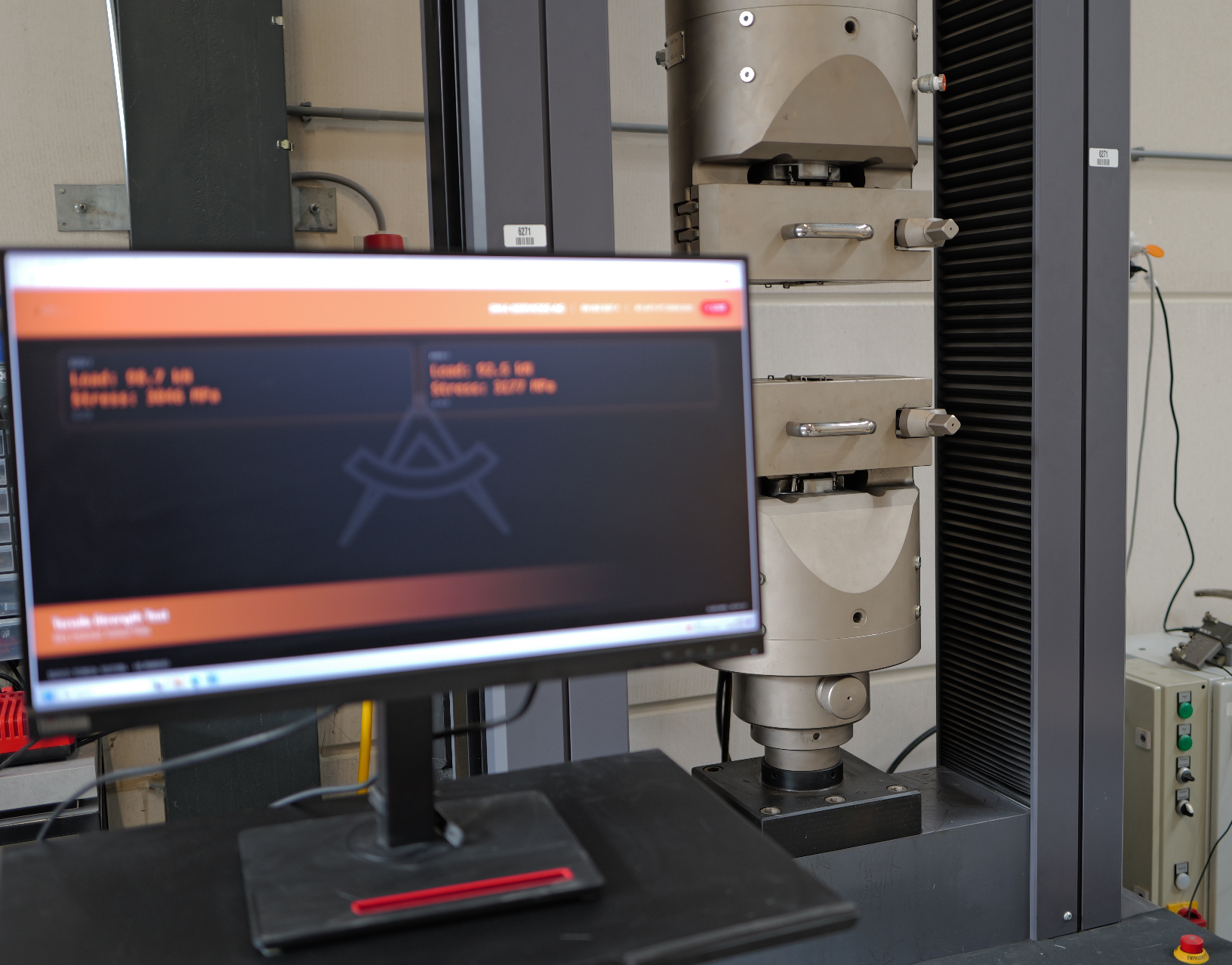
Adhesion of the cured system to representative substrates (concrete, timber-based boards, insulation boards, metal decks, existing bituminous membranes) is measured with a tensile pull-off test. Results are used, in combination with the substrate's own resistance, to derive the wind uplift capacity of the fully bonded assembly.
Static and Dynamic Indentation
The membrane's ability to resist point loads and impact is assessed according to EN 12730 (static loading) and EN 12691 (dynamic impact by falling mass). Different user load categories (P1 to P4) correspond to different test severities.
Fire Testing
External fire performance is determined according to CEN/TS 1187 with classification per EN 13501-5. Reaction to fire is determined using SBI (EN 13823) and small flame tests, with classification per EN 13501-1. Testing is performed on the full build-up including insulation and substrate, because the classification is system-specific.
Note on current fire testing capability: At this time, Amstelfy can already perform reaction-to-fire classification per EN 13501-1, the single-flame source test per EN 11925-2, and external roof fire testing to BROOF(t1). Other fire test methods referenced in the EAD are still under development in our laboratory scope.
Thermal Compatibility and Temperature Resistance
Samples are exposed to the declared lowest and highest surface temperatures and cycled between them to verify that no cracking, blistering, delamination or loss of adhesion occurs. This is particularly relevant for dark-coloured membranes on southern-European roofs, which can exceed +80 °C.
AVCP System and Certification Route
LARWK generally fall under AVCP System 3 for reaction to fire (Euroclass) declarations, and AVCP System 2+ for the other essential characteristics — meaning that Factory Production Control certification by an accredited certification body is required. For products with a declared reaction-to-fire class dependent on the manufacturing process, AVCP System 1 may apply.
The route to CE marking follows these steps:
- ETA application to a Technical Assessment Body (TAB) referring to EAD 030350-00-0402.
- Type testing in an accredited ISO/IEC 17025 laboratory covering all declared essential characteristics.
- Initial inspection of the manufacturing plant and of the FPC by an accredited certification body (ISO/IEC 17065).
- Issuance of the Certificate of Constancy of Performance (System 2+) for the FPC.
- Declaration of Performance (DoP) drawn up by the manufacturer.
- CE marking affixed by the manufacturer on the basis of the ETA, the type test results, and the FPC certificate.
- Continuous surveillance of the FPC by the certification body.
Factory Production Control for LARWK
FPC requirements for liquid-applied systems focus on the chemistry, the reproducibility of the cured film, and the traceability of every batch:
- Incoming inspection of raw materials — resins, isocyanates, initiators, catalysts, fillers, pigments, reinforcement fabrics, primers.
- Batch testing of viscosity, solid content, density, gel time, and pot life for each production batch.
- Verification of cured film properties on retained samples: tensile strength, elongation at break, Shore hardness, and thickness.
- Watertightness verification on periodic samples representing production.
- Full batch traceability from raw material lot to packaged product and shipment record.
- Control of storage conditions and shelf life of reactive components.
Common Pitfalls in LARWK Assessment
- Substrate scope too narrow: An ETA is only valid for the substrates listed in it. Manufacturers often need to extend scope to concrete, timber, insulation, or metal decks — each requires adhesion and compatibility testing.
- Reinforcement variations: Changing the fabric weight, weave, or supplier can affect crack-bridging and mechanical performance. Any variation must be covered by the ETA or trigger supplementary testing.
- Fire classification limits: External fire and reaction-to-fire results are system-specific. A change in insulation, primer, or top coat can invalidate the classification.
- Working life claims: Declaring W3 (25 years) requires the full accelerated ageing programme. Manufacturers should not declare a working life category that has not been substantiated through testing.
- Legacy ETAG 005 documents: Renewals must be rewritten against EAD 030350-00-0402; a straight extension of an ETAG-based ETA is no longer acceptable.
How Amstelfy Supports LARWK Manufacturers
Amstelfy provides end-to-end support for manufacturers of liquid applied roof waterproofing kits seeking European market access:
- Accredited testing (ISO/IEC 17025): Watertightness, ageing, crack bridging, indentation, adhesion, and thermal performance testing in accordance with EAD 030350-00-0402.
- FPC certification (ISO/IEC 17065): Initial inspection and continuous surveillance of factory production control, leading to the Certificate of Constancy of Performance.
- ETA consultancy: Support with ETA applications, scoping of substrates and use categories, liaison with Technical Assessment Bodies, and preparation of technical documentation.
- Legacy conversion: Migration of existing ETAG 005-based assessments to the current EAD framework, including gap analysis and supplementary testing plans.
Whether you are launching a new PMMA, polyurethane, or hybrid LARWK, extending your ETA to new substrates or working life categories, or transitioning from ETAG 005 to EAD 030350-00-0402, our team guides you through every stage of testing, assessment, and certification.