Fibre reinforced polymers (FRP) have moved from niche repair applications to mainstream structural use: GFRP and BFRP bars replacing steel in corrosion-critical concrete, CFRP laminates and sheets strengthening bridges and slabs, FRCM and CRM systems retrofitting masonry, and pultruded profiles carrying load in façades and walkways. Because almost none of these products are covered by a harmonised standard, their route to the European market runs through an ETA — and an ETA is only as strong as the test programme behind it.
Which Products Fall in Scope
Our ISO/IEC 17025 accredited laboratory tests the full range of composite construction products:
- FRP reinforcing bars and connectors — GFRP, BFRP, CFRP and AFRP bars, stirrups, headed bars, ties and shear connectors used as internal reinforcement in concrete.
- Externally bonded reinforcement (EBR) — carbon and glass fabrics, pre-cured laminates and near-surface-mounted strips bonded with epoxy to concrete, steel or timber.
- FRCM and CRM systems — fabric- or composite-reinforced cementitious matrix systems for masonry and concrete strengthening.
- Structural FRP elements — pultruded profiles, gratings, sandwich and composite panels, and façade elements.
The Governing EADs
Two European Assessment Documents dominate the composite field:
- EAD 160004-00-0301 — Glass fibre reinforced polymer (GFRP) bars for concrete reinforcement. It defines the essential characteristics of the bar as internal reinforcement: tensile strength and modulus, bond to concrete, transverse shear, bent-bar strength, creep rupture, fatigue, and durability in alkaline environment.
- EAD 340275-00-0106 — Externally bonded FRP systems for strengthening concrete structures. It addresses the system — fibre, resin, primer, putty and installation procedure — rather than the fibre alone: laminate tensile properties, bond and pull-off to the substrate, glass transition temperature of the resin, and durability after environmental conditioning.
Always cite the current EAD number. Assessment references that predate the EAD system have been superseded and are no longer a valid basis for a new ETA.
Core Mechanical Test Programme
Tensile Properties
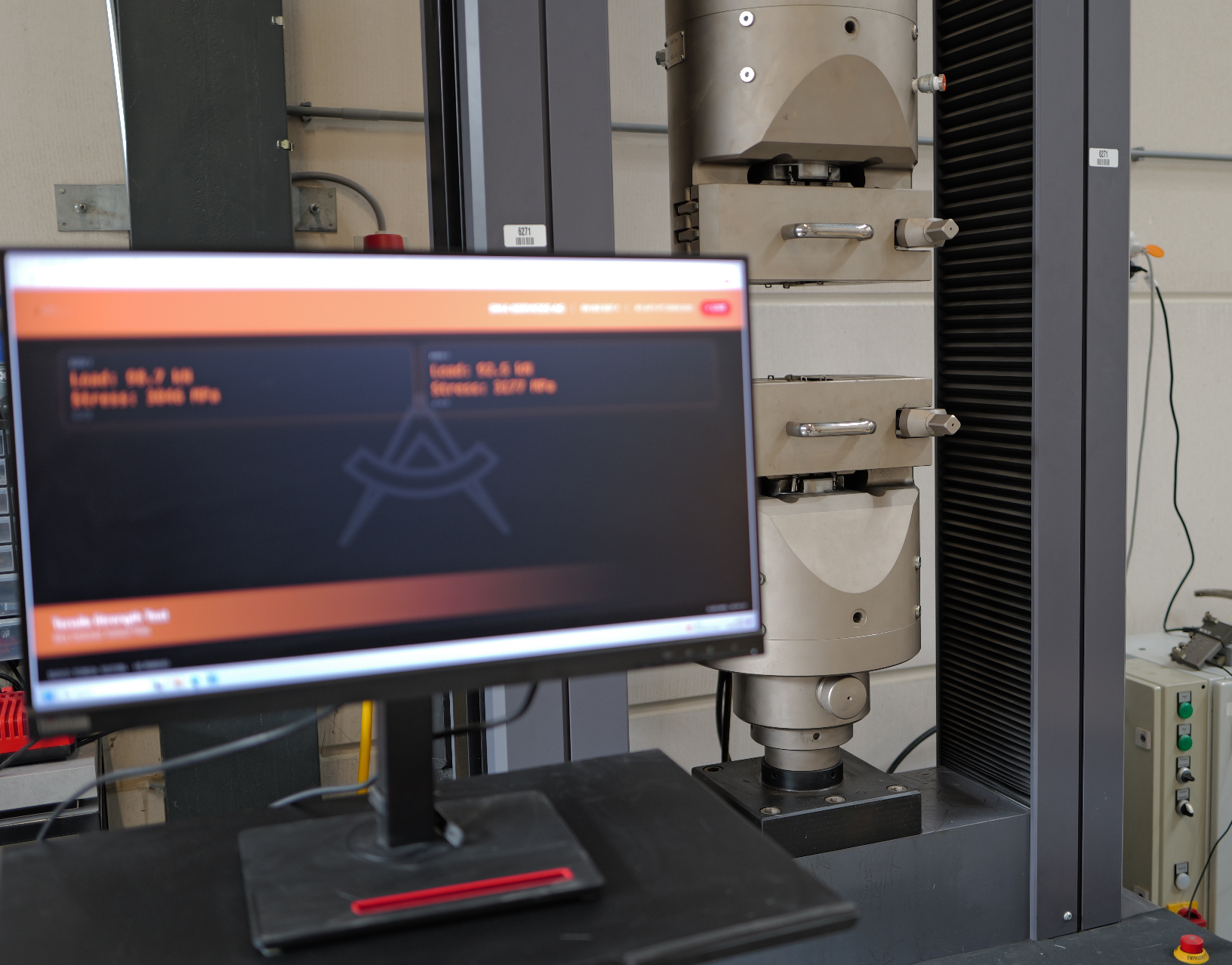
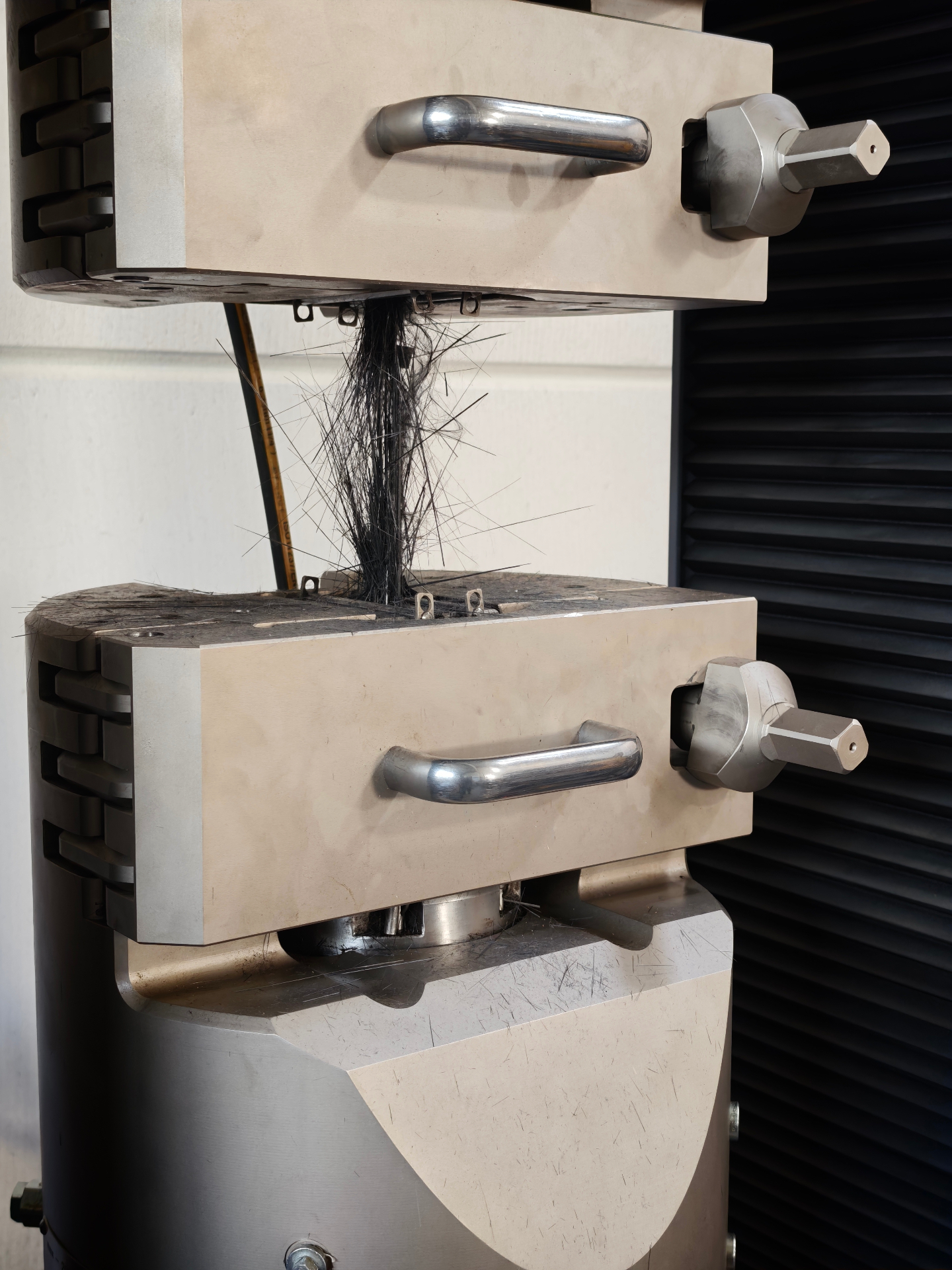
Tensile testing to ISO 527-4 / ISO 527-5 (and ASTM D3039 or ASTM D7205 for bars) yields tensile strength, modulus of elasticity, strain at failure and Poisson's ratio. FRP bars require anchor-sleeve grips filled with expansive grout or resin so that failure occurs in the free length rather than in the jaws — a detail that decides whether a result is valid. Strain is measured with an extensometer or bonded strain gauges, and the nominal cross-section for ribbed or sand-coated bars must be determined by immersion, not by calliper.
Flexural, Compressive and Shear Properties
Flexural behaviour is measured in three- or four-point bending to ISO 14125, in-plane compression to ISO 14126, and apparent interlaminar shear strength by the short-beam method to ISO 14130. For pultruded profiles, the anisotropy of the material means each direction — longitudinal, transverse and through-thickness — needs its own specimen set.
Bond and Pull-off
For internal reinforcement, bond to concrete is measured by pull-out and beam-end tests, giving the bond stress–slip relationship used in design. For externally bonded systems, adhesion is measured by pull-off testing on the prepared substrate, and by double-lap shear tests that quantify the effective bond length and the debonding energy — the parameter that actually governs the strengthening capacity in service.
Glass Transition Temperature
The Tg of the polymer matrix, determined by DSC or DMA, is a mandatory characteristic. It sets the maximum service temperature: an EBR system installed on a car park deck that reaches Tg − 15 °C will lose stiffness and bond long before the fibre is stressed. Site-cured epoxies frequently show a Tg well below the laboratory-cured value, so the declared value must reflect the realistic curing regime.
Durability: Where FRP Assessments Are Won or Lost
Mechanical strength is rarely the limiting factor for composites — long-term retention is. The EADs therefore require conditioning followed by residual property testing:
- Alkaline conditioning — immersion in a simulated pore solution (pH ≈ 12.7–13.0) at elevated temperature, with and without sustained load, to quantify the environmental reduction factor for GFRP and BFRP bars.
- Moisture and hygrothermal ageing — water immersion and humid heat cycling to assess matrix plasticisation and fibre–matrix interface degradation.
- Freeze–thaw cycling — critical for external strengthening in northern and alpine climates.
- Creep rupture and relaxation — sustained-load tests over extended periods, used to extrapolate the permissible long-term stress level (typically a fraction of the short-term tensile strength).
- Fatigue — cyclic loading at defined stress ratios, essential for bridge and crane-runway applications.
- UV and weathering — for exposed profiles and unprotected laminates.
Residual properties after conditioning are compared to the unconditioned baseline; the retention ratio feeds directly into the design values published in the ETA.
Fire Performance
Reaction to fire is classified to EN 13501-1, with the single-flame source test to EN ISO 11925-2 and SBI to EN 13823. Because polymer matrices soften near Tg, fire design of FRP-strengthened members usually relies on protective systems, and any declared class applies to the complete build-up tested, not to the fibre alone.
Note on current fire testing capability: Amstelfy can perform reaction-to-fire classification per EN 13501-1 and the single-flame source test per EN ISO 11925-2. Additional fire test methods referenced in the composite EADs are still under development in our laboratory scope.
Factory Production Control for Composite Products
Composite manufacturing is process-sensitive, so FPC focuses on the parameters that control the cured product:
- Incoming inspection of fibres, sizing, resins, hardeners, fillers and release agents, with batch traceability.
- Control of fibre volume fraction, resin content (burn-off or digestion), and void content.
- Monitoring of pultrusion line speed, die temperature profile and cure state (degree of cure by DSC).
- Dimensional control of bars, ribs, sand coating and laminate thickness.
- Periodic tensile, flexural and interlaminar shear testing on production samples.
- Storage and shelf-life control of reactive resin components.
Route to Market
- Gap assessment — confirm which EAD applies and which essential characteristics must be declared for the intended use.
- Type testing in an ISO/IEC 17025 accredited laboratory, including the durability conditioning programme, which typically drives the schedule.
- ETA issuance by a Technical Assessment Body on the basis of the test results.
- Initial inspection of the plant and FPC by an accredited certification body (ISO/IEC 17065), leading to a Certificate of Constancy of Performance under AVCP System 1+ or 2+ depending on the product.
- Declaration of Performance and CE marking by the manufacturer, followed by continuous surveillance of the FPC.
How Amstelfy Supports Composite Manufacturers
Our laboratory performs the mechanical, bond, thermal and durability programmes described above under ISO/IEC 17025 accreditation, and our certification body issues Certificates of Constancy of Performance under ISO/IEC 17065. We can plan the full test matrix against the applicable EAD, run the conditioning campaign, and support the FPC implementation required before certification. Consultancy support is delivered independently of certification decisions to preserve impartiality.